Posts

Immortal Cooperation
Image
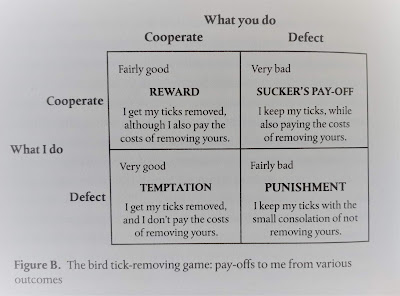
Book Review: Richard Dawkins, "The Selfish Gene", Oxford University Press, 2016 (40th anniversary edition). If the name Richard Dawkins rings a bell, it might be because he is a prominent atheist and author of The God Delusion . But he is also a well-respected evolutionary biologist at the University of Oxford and a Fellow of the Royal Society. The book that launched him to fame, all the way back in 1976, was The Selfish Gene , which today can be bought in its 40th anniversary edition. It has been recommended as reading for aspiring rationalists, and following Bill Bryson's "A Short History of Nearly Everything" I've been more keen on natural sciences. So, today I'll explain to you the hype behind The Selfish Gene . The first thing to address is the title, since it tends to confuse people. This is not a book about how people are selfish; it is a book about how genes  are "selfish" in the sense that they care only about increasing thei...

Life on the Hamster Wheel

Image
Book Review: Charles Duhigg, "The Power of Habit: Why We Do What We Do in Life and Business", Random House, 2014. Previously I've written about the shopper research of Siemon Scamell-Katz, which paints an unflattering picture of humans in their modern habitat. For example, it seems that people don't look into the window before they enter a store, don't recall the name of the store they are in, don't find the products they are looking for even though those products are in the store, don't read signs, and remember almost none of the brand messages they are exposed to. Some people will say that a store is fantastic and that they've shopped through the whole store, while film footage shows them actually covering half the store and experiencing inconvenience. These post-hoc rationalizations occur because much of the time, people shop on "autopilot" -- and they tend to buy the same brands in the same stores. Scamell-Katz talks about behaviora...

Ten Money Mistakes to Avoid

Image
Book Review: Dan Ariely and Jeff Kreisler, "Dollars and Sense: How We Misthink Money and How to Spend Smarter", Harper, 2018. If you are familiar with the research on cognitive heuristics and biases, then you have probably heard of Dan Ariely -- the Duke professor who founded the Center for Advanced Hindsight and wrote a number of bestsellers including "Predictably Irrational", "The Upside of Irrationality" and "The (Honest) Truth About Dishonesty". His latest book is a collaboration with the comedian Jeff Kreisler, who speaks a lot on the topic of money. It is called, in a punny way, Dollars and Sense  (although there is also a British edition titled Small Change: Money Mishaps and How to Avoid Them ). In the Introduction, the authors emphasize the relevance of a book like this: we all think about money on a regular basis because it touches most aspects of our lives. Yet by thinking about it, we don't necessarily make good decisions....

Don't Be a Sucker

Image
Book Review: Nassim Nicholas Taleb, "The Black Swan: The Impact of the Highly Improbable", Penguin Books, 2010. The MIRI and LessWrong founder, Eliezer Yudkowsky, once wrote : "There is a meme which says that a certain ritual of cognition is the paragon of reasonableness and so defines what the reasonable  people do. But alas, the reasonable people often get their butts handed to them by the unreasonable  ones, because the universe isn't always reasonable . [...] If you keep on losing, perhaps you are doing something wrong . Do not console yourself about how you were so wonderfully rational in the course of losing. That is not  how things are supposed to go. It is not the Art that fails, but you who fails to grasp the Art." At the very least, a rationalist should avoid shooting their own foot off. As a corollary, they should avoid being a sucker -- which is certainly what the philosopher/statistician/trader/essayist Prof. Nassim Nicholas Taleb would say...