Posts

Showing posts with the label nassim nicholas taleb

Thriving on Entropy

Image
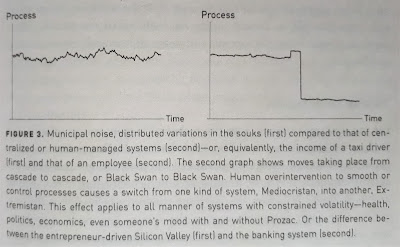
Book Review: Nassim Nicholas Taleb, "Antifragile: Things that Gain from Disorder", Penguin Books, 2013. In his book Adapt , Tim Harford argues that we should be experimenting with multiple projects in parallel since not all of them will pay off, but when an experiment is successful, it can transform our lives for the better "in a way that a failed experiment will not transform them for the worse". This asymmetry lies at the heart of Nassim Nicholas Taleb's book Antifragile , which promotes the idea of antifragile tinkering or bricolage -- a kind of trial-and-error in which small mistakes are good and one wishes to "fail fast", because this gives one the option to keep a hugely favorable result while limiting the bad, as long as one has the rationality to identify and exploit large gains. (Incidentally, Taleb wrote a review for Harford's Adapt with rare praise: " Adapt is a highly readable, even entertaining, argument against top-down de...

31 Talebian Meditations, Part 3

Image
This is the final part of a three-part series on The Bed of Procrustes (2nd Penguin ed., 2016). In case you need a reminder or you started here, the goal of this exercise was to pick at random (with the help of technology ) an aphorism from N.N. Taleb's book for each of the 31 days of January, and write a brief reflection on it. Here are the first two parts: Part 1 and Part 2 . Now, let us continue. *** 21. "Contra the prevailing belief, "success" isn't being on top of a hierarchy, it is standing outside all hierarchies." (p. 133) Humans naturally respond to status, and the fact that status is relative means that hierarchies, whether formal or informal, are nearly inevitable. So, I'm not sure if it's possible to be truly outside all hierarchies without being a hermit... Yet you can choose not to deliberately climb higher on any particularly visible hierarchy. Rather than judging your success by what others have accomplished, you can strive ...

31 Talebian Meditations, Part 2

For an introduction and background to this post, see Part 1 here . Remember, these aphorisms are randomly selected, so it's not about what I think are the most important ones from The Bed of Procrustes . (After I finish the book, I might give an update with my personal favorites. Update 09 Feb: Part 3 is now live.) That being said, let's proceed. *** 11. "Your reputation is harmed the most by what you say to defend it." (p. 11) When Bill Clinton denied having had sexual relations with Monica Lewinsky, he was probably trying to defend his reputation. Of course, it backfired when people found out he lied. Our intuition when faced with a sullying accusation is to try and take control of the situation, but the more we do so, the more people suspect that we have something to hide. Even if we come clean and apologize, the effect on our reputations may not be as we hoped for: studies show that when public figures apologize, some people in the audience are more pron...

31 Talebian Meditations, Part 1

Image
Book Review: Nassim Nicholas Taleb, "The Bed of Procrustes: Philosophical and Practical Aphorisms", Penguin Books, 2016. Today's post will be a bit different, since I'm writing about a unique book, The Bed of Procrustes. Unlike previous books by the author (see Fooled by Randomness  and The Black Swan ), this one is a short (fewer than 160 pages) "addendum" to the Incerto  consisting of various collected aphorisms. These poetic sayings, maxims or proverbs compress the author's ideas into a sentence or two, in a "show of bravado" (the author's own words). As Nassim Nicholas Taleb explains in the Postface: "You never have to explain an aphorism -- like poetry, this is something that the reader needs to deal with by himself. [...] Aphorisms require us to change our reading habits and approach them in small doses; each one of them is a complete unit, a complete narrative dissociated from others." (pp. 154-155). Nevertheless, t...