Posts

31 Talebian Meditations, Part 3

Image
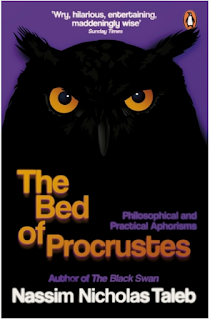
This is the final part of a three-part series on The Bed of Procrustes (2nd Penguin ed., 2016). In case you need a reminder or you started here, the goal of this exercise was to pick at random (with the help of technology ) an aphorism from N.N. Taleb's book for each of the 31 days of January, and write a brief reflection on it. Here are the first two parts: Part 1 and Part 2 . Now, let us continue. *** 21. "Contra the prevailing belief, "success" isn't being on top of a hierarchy, it is standing outside all hierarchies." (p. 133) Humans naturally respond to status, and the fact that status is relative means that hierarchies, whether formal or informal, are nearly inevitable. So, I'm not sure if it's possible to be truly outside all hierarchies without being a hermit... Yet you can choose not to deliberately climb higher on any particularly visible hierarchy. Rather than judging your success by what others have accomplished, you can strive ...
31 Talebian Meditations, Part 2

For an introduction and background to this post, see Part 1 here . Remember, these aphorisms are randomly selected, so it's not about what I think are the most important ones from The Bed of Procrustes . (After I finish the book, I might give an update with my personal favorites. Update 09 Feb: Part 3 is now live.) That being said, let's proceed. *** 11. "Your reputation is harmed the most by what you say to defend it." (p. 11) When Bill Clinton denied having had sexual relations with Monica Lewinsky, he was probably trying to defend his reputation. Of course, it backfired when people found out he lied. Our intuition when faced with a sullying accusation is to try and take control of the situation, but the more we do so, the more people suspect that we have something to hide. Even if we come clean and apologize, the effect on our reputations may not be as we hoped for: studies show that when public figures apologize, some people in the audience are more pron...

31 Talebian Meditations, Part 1

Image
Book Review: Nassim Nicholas Taleb, "The Bed of Procrustes: Philosophical and Practical Aphorisms", Penguin Books, 2016. Today's post will be a bit different, since I'm writing about a unique book, The Bed of Procrustes. Unlike previous books by the author (see Fooled by Randomness  and The Black Swan ), this one is a short (fewer than 160 pages) "addendum" to the Incerto  consisting of various collected aphorisms. These poetic sayings, maxims or proverbs compress the author's ideas into a sentence or two, in a "show of bravado" (the author's own words). As Nassim Nicholas Taleb explains in the Postface: "You never have to explain an aphorism -- like poetry, this is something that the reader needs to deal with by himself. [...] Aphorisms require us to change our reading habits and approach them in small doses; each one of them is a complete unit, a complete narrative dissociated from others." (pp. 154-155). Nevertheless, t...

Welcome to 2020!

It has been two years since I started this blog. In that time, I've published 42 posts and received over 13,000 page views (though I'm not sure how many of those are spam referrals...). This is a quick update on what I plan to write in the coming month(s): > I'm currently working on a summary/review of Nassim Nicholas Taleb's books Antifragile  and The Bed of Procrustes . After that I'll be taking a break from Taleb for a while. > For The Bed of Procrustes , I'm doing something different since the book is also... different. I'll be giving more of my own thoughts on the topic rather than mostly summarizing. > I am also reading Thaler and Sunstein's famous Nudge , which will of course be reviewed in due time.

The Fat Lady Sings Stochastically

Image
Book Review: Nassim Nicholas Taleb, "Fooled by Randomness: The Hidden Role of Chance in Life and in the Markets", Penguin Books, 2007. First published in 2001 (with an updated edition in 2004), Nassim Nicholas Taleb's Fooled by Randomness marks the first book in the "Incerto" series. It was selected by Fortune magazine as "one of the smartest books of all time" -- that's setting some high expectations! In my own opinion, this book is somewhat underwhelming after reading The Black Swan  (and I recently finished Antifragile , which is also more original and expansive). But that being said, Fooled by Randomness  is not a bad book; it is still a showcase of the author's wit, and marks a transition point between his life as a trader and as a literary essayist and professor. One can even witness the author's thinking shift from the "randomness foolishness" of Wall Street (this book), to examining the rare event  more broadly ( The ...

The Bumpy Road

Book Review: Tim Harford, "Adapt: Why Success Always Starts with Failure", Hachette Digital, 2011. In my review of The Undercover Economist  and The Undercover Economist Strikes Back , I noted that there is also a third Tim Harford book on Conceptually's bookshelf . Indeed, that book is Adapt  -- a book about bottom-up trial-and-error approaches to solving complex problems. For an economist who believes in the power of markets, this seems like a logical literary foray. ( Recall that, for economists L. von Mises and F. Hayek, the market's price system functions as a decentralized "economic calculator".) However, Adapt is about much more than economics; it touches on a diverse range of issues including terrorism, climate change, innovation, evolution, nuclear accidents, and even art. In the first of eight chapters, the author talks about how the complexity of the modern world can make it hard to solve problems, even for leaders and experts. Even the l...

An Insider's Guide to the Economy

Image
Book Review: Tim Harford, "The Undercover Economist: Exposing Why The Rich Are Rich, The Poor Are Poor -- And Why You Can Never Buy A Decent Used Car!", Oxford University Press, 2006. ~and~ Tim Harford, "The Undercover Economist Strikes Back: How to Run -- Or Ruin -- An Economy", Riverhead Books, 2014. The last time on my blog that I reviewed two books together was more than a year ago, when I wrote " Of Animals and Machines ". Both of those books ( Animal Spirits  and The Second Machine Age ) were about economics; this time, both books are about economics again -- but by one author. Tim Harford is an economist, journalist, TED speaker , and author of several books. His first book, The Undercover Economist , is probably his most famous. The sequel, The Undercover Economist Strikes Back , arrived almost a decade later. The main difference between these books is that the former focused more on microeconomics, whereas the latter focused more on macroec...